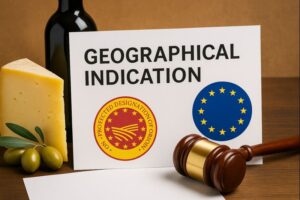

The protection of Geographical Indications in the European Union today forms a legal network as influential as it is silent. Designed to protect the authenticity of products linked to a territory, this system has become a decisive actor in the fate of new brands in the food and wine sector. A single unexpected evocation can bring a brilliant project to an abrupt halt.
At 1919polo, we see how many entrepreneurs discover too late that the name chosen for their wine, cheese, oil or even their gourmet sauce is blocked by a geographical reference they never imagined would be problematic. The key to avoiding this is to consult, before any move is made, the European databases that determine which names are legally protected.
1. A Legal System Where Evocation Is Everything
The principle is simple: when a product is deeply linked to a territory, its name forms part of its identity. And that identity is protected even against subtle evocations. Literal similarity is no longer required.
Thus, a brand such as “Valdehigo” for meat products can create problems with Valdepenas, not because it sounds the same, but because a mental association in the consumer’s mind can arise. A cheese project named “Montelarreina”, despite being based on a real place name, could be interpreted as a vague evocation of designations such as Montana de Leon or Reina de los Picos. A honey brand called “Calandria” may find itself confronted with the fame of Melocoton de Calanda, especially if the graphic design plays on yellow tones or references to the territory.
We have also seen gourmet brands such as “Alpisterra” — intended for canary seed biscuits — analysed under the lens of alpine evocations, entering into conflict with Central European GIs for cheeses or butters. Evocation, in short, has become more literary than literal, and also more dangerous.
2. How Trademarks Are Examined: The Real Weight of Databases
EUIPO and OEPM examiners do not operate on intuition, but through direct consultation of an ecosystem of databases that determines whether a name can be registered. In that universe, three platforms decide the fate of many brands: eAmbrosia, GIview and internal tools such as CESTO.
A tour through GIview reveals the extent to which small projects run into prestigious giants. Brands such as “Sorrentina” for sauces may encounter a battery of Italian GIs covering everything from lemons to dairy products. A tea brand called “Assamica” can trigger alerts due to its resemblance to GIs from the Indian region of Assam. A chocolate brand called “Arriba Coast” could collide with the reputed Ecuadorian GI Cacao Arriba, even if the product is manufactured in Europe.
3. eAmbrosia, GIview and CESTO: The Invisible Guardians of the Market
3.1. eAmbrosia — The Official Register That No One Can Bypass: This database brings together all European PDOs, PGIs and TSGs. There, Champagne, Chianti and Porto coexist with Spanish products such as Sobrasada de Mallorca, Pan de Cea or Mantequilla de Soria. If a term appears in eAmbrosia, it is legally protected. Recent examples show how names as diverse as “Montflor”, “Calicanto” or “Fiorleche” have been challenged for their phonetic resonances with Italian cheese GIs or French dairy products.
3.2. GIview — EUIPO Practical Tool: It is the radar that detects, in seconds, whether a name treads on protected ground. A search for “La Vera” immediately triggers alerts due to the strength of Pimenton de la Vera. Entering “Reblochonette” is enough for the shadow of Reblochon to fall over the application.
3.3. CESTO — The Internal Filter of the Offices: While eAmbrosia and GIview dominate the public sphere, CESTO is the internal engine that traces conflicts and precedents. It is, in many respects, the engine room of refusals.
4. A Demanding System, But Full of Opportunities
The greatest risk for a company is clear: outright refusal. But knowledge of GIs also offers a competitive advantage. Whoever handles these databases with precision can design stronger brands, anticipate conflicts and move confidently in a market where territorial identity is a powerful commercial argument.
Many recent successes in oil, cheese and wine have not arisen despite GIs, but thanks to a strategic coexistence with them. Understanding them means understanding the cultural and legal map on which one competes.
5. The Essential Strategy: Search Before You Create
The recommendation is unequivocal: before printing a label, commissioning a logo or preparing a launch, eAmbrosia, GIview and the national registers must be consulted. A minute of searching avoids months of correction.
At 1919polo, we accompany producers who have avoided costly mistakes thanks to this prior step. Some discovered that their brand unintentionally evoked GIs as varied as Gouda Holland, Roquefort, Peking Duck or Cafe de Colombia. Others found that a name with romantic resonances interfered with the protection of Azafran de La Mancha or Queso Idiazabal.
Knowledge, in this field, is more than power: it is pure prevention.
Conclusion: Branding in the Age of Databases
Geographical Indications are today a decisive actor in the European market. They not only protect traditional products; they also influence naming, commercial strategy and the viability of many brands. Knowing the databases that underpin them is indispensable for navigating the sector with confidence and ambition.
In a world where a single word can open doors or close them, these tools have become the true guardians of the market. And at 1919polo, we are ready to interpret them with you.